Anyone who has ever left the groomed slopes with their normal carving skis will probably have quickly realised that powder crusing is not as easy as it looks. What helps is having the right equipment for your deep snow adventures. This is precisely why there are special freeride models for off-piste skiing.
In this article, our RENTertainers look at the perfect deep snow skis. We show you which features a model for the backcountry needs to fulfil, which ski length is the right one and how you can adapt your riding style so that the run down into the valley is an unforgettable experience.
What are models for deep snow skiing?
Deep snow skis are specially designed for off-piste skiing. There are a few important features to ensure that they are fun to use in the backcountry and offer full control in powder:
Differences to normal skis:
- Wide ski centre: In contrast to carving models, freeride skis do not have such a pronounced waist. Instead, deep snow skis have a centre width of 95 to 125 mm to provide sufficient uplift.
- Longer skis: In order to be able to float on the surface, the contact point on freeride models is usually further back. As a result, deep snow skis are generally longer than comparable slope models.
- Rocker profiles: Carvers have a positive camber. If you look at the profile from the side, there is a small gap to the ground under the binding. A rocker, on the other hand, is a negative camber: the ends of the ski are bent upwards like a banana. This reduces the effective contact area. The side profile looks different depending on the type of rocker.
- Twintip vs. directional shape: Although not every deep snow ski is suitable for off-piste adventures, there are at least some freeride models that have a bent tip at the front as well as the rear. This means you can also ski backwards or "switch" in off-piste terrain. The opposite of this is called a "directional shape", i.e. a profile shape for skiing in one direction.
Many deep snow skis are designed to cope with different types of snow in the terrain. Although you can ride your freeride models in the same way on the slope, you will quickly realise that much more power is required to steer precisely. What's more, at higher speeds on the slope, the skis start to flutter. The reason for this is the pronounced rocker profile. The shorter, effective edge length ensures less stability.
The advantages and disadvantages of a ski with a rocker profile
The rocker profile varies depending on the area of use. This results in different handling characteristics, which have advantages and disadvantages for use on and off the slopes:
Advantages:
- A pronounced rocker enables a lot of lift.
- Thanks to their shape, freeride skis are easier to turn and facilitate steering impulses.
- Beginners in particular benefit from the rocker profile, as it "forces" them to adopt a central stance and a relaxed skiing position. The shape also forgives more skiing mistakes.
Disadvantages:
- The skis start to flutter on the slope at higher speeds.
- In addition, deep snow models with a lot of rocker are more unstable on hard packed snow.
- Due to the shorter effective edge length, the skis don't give as much feedback, which would be an advantage in steep, demanding terrain.
Which profile is right for you depends primarily on the situations in which you will be using deep snow skis. The more often you will be out in powder, the more in favour of a pronounced rocker profile. If you are unsure, you also have the opportunity to test different variants at INTERSPORT Rent. Swing by and benefit from the advice of our RENTertainers on site.
What is the optimum ski length for freeride skis?
The length of deep snow skis is usually between your own height and 15 centimetres longer. They are therefore significantly bigger than the usual carvers you know from the slopes. Why is that? Long skis in combination with a rocker profile offer a lot of floating ability in deep snow and a lot of stability at high speeds in the off-piste terrain. Freeride beginners are best advised to start with a pair of skis that match their own height. The more pronounced the rocker shape, the longer the ski should be.
Deep snow skis also have a centre width of 95 to 125 mm. Basically, you can remember this: The more time you spend in deep snow, the wider the ski can be.
Tip: If you are looking for playful planks for the backcountry, you need a freeride model with a twintip shape! This is a type of ski where not only the front tip but also the rear tip is bent upwards. This means you can also ride switch off-piste, allowing you to perform tricks where you either land or ski backwards.
Deep snow skis: overview of lengths
This table is intended to give you initial recommendations on the perfect length of possible models. As always, the information is for guidance only!
| Height and weight of the skier | Recommended length for freeride skis |
| Height: 150-160 cm Weight: 45-55 kg |
155-165 cm |
| Height: 160-170 cm Weight: 55-65 kg |
165-175 cm |
| Height: 170-180 cm Weight: 65-75 kg |
175-185 cm |
| Height: 180-190 cm Weight: 75-85 kg |
185-190 cm |
When making your choice, remember that ski length is only one aspect that determines good performance. In addition to height, the centre width, the shape of the rocker and your own body weight are also decisive. It can occur that the same performance is given between models despite different ski lengths.
Tip: Especially when riding deep snow, it is a good idea to test the skis in advance. Get advice from our RENTertainers on site and try out different models. This will give you a good feel for how each feature affects skiing.
Deep snow skis: What types are there?
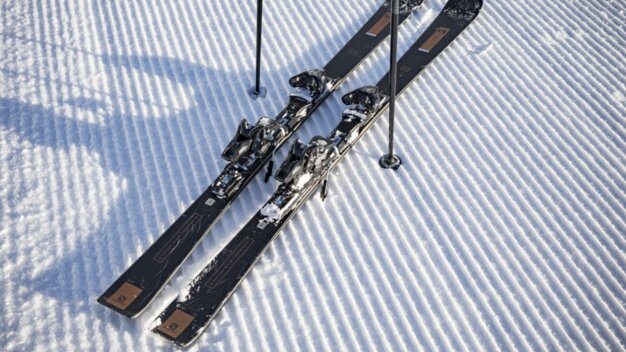
As briefly mentioned above, deep snow models are a generic term that summarises many types of skis - the boundaries between them are fluid. These include:
- Directional powder skis
- Freeride skis including the Freetourer category
- All-mountain models with pronounced deep snow characteristics
Which ski you choose depends primarily on the planned area of use. In this context, ask yourself whether you will be using the skis exclusively or only partially in deep snow. The snow conditions and the type of terrain can also be decisive factors.
Tip: Freeride skis are also suitable as touring skis. However, bear in mind that most models are much heavier and therefore you have to carry more weight with every step up the mountain! Instead, look out for the freetouring category.
Directional powder skis
Directional deep snow skis are models with a shape that has been optimised for straight-line off-piste skiing. The most extreme form of directional ski is definitely a fishtail shape. As these models are used only for powder skiing, they usually have a centre width of at least 110 mm. This not only gives them very good flotation properties, but also a wide radius of up to 30 metres, which means you can almost surf on the snow.
If you need a pair of skis for really snowy days and you're looking for high-speed performance in even the trickiest off-piste situations, you've come to the right place.
Freeride skis
The term freeride ski is actually a collective term for all deep snow models that are more playful. In this context, playful means that the ski type is better suited to performing tricks. One of the most obvious characteristics in this context is definitely the twintip shape, which also makes it possible to ski backwards. The waist of freeride models is usually between 110 and 120 mm. Normal freeride skis are also quite heavy, which means that they are not only very stable in the terrain, but can also absorb impacts from hard ground and changeable snow conditions very well.
Freetouring skis or freetourers
Among the "normal" freeride models, there are also the so-called freetouring skis or freetourers. While conventional ones are relatively heavy, this variant focuses more on weight. You could see them as lighter freeride skis for ski touring.
They guarantee just as much playfulness, but with less weight. This means you have to lift less with every step on the ascent in order to make progress. Especially on longer tours with a lot of vertical metres, a few grams can make a big difference. To achieve this, freetourers usually have a narrower centre width of 105 to 115/120 mm and lighter materials such as carbon.
Conventional freeride skis are the perfect choice for anyone who - as soon as it snows - wants to go off-piste and spend the whole day flying over natural kickers or jumping off cliffs. If you want to use the ski resort's infrastructure for the ascent to get as many runs as possible, a normal freeride ski is the right choice. If you appreciate precisely these characteristics but prefer to climb the peaks under your own steam away from the crowds, you are better off opting for freetouring skis.
Skis for the slope and deep snow: the category of all-mountain skis
All-mountain skis are still in the fast lane! No wonder, because they are suitable for use both on and off the slopes. In contrast to the models mentioned above, their centre width is narrower. They have a waist width of 80 to 110 mm, which means that steering impulses can still be set well on the slope without exerting too much force. All-mountain skis are therefore wider slope skis that have adopted some features, such as a rocker shape, from the "real" deep snow skis.
All-mountain skis are the perfect choice for anyone who spends most of their time on the slopes in winter, but also likes to venture off-piste. It's not necessarily about mastering the untouched slopes in the distance. It is more about having fun in ankle-deep snow without straying too far from the secured ski area.
Tip: Advanced skiers who like to go full throttle should choose a moderate rocker shape for an all-mountain ski. This provides flotation and still guarantees enough stability at higher speeds on the groomed slopes. For beginners who are not yet going too fast, models with a more pronounced rocker are ideal.
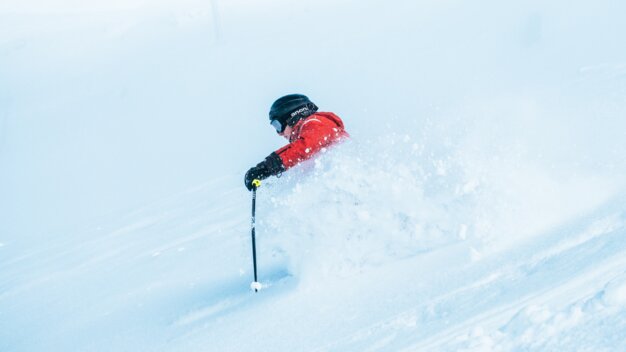
Skiing in deep snow: how to do it right
The skiing technique in deep snow is very different from "normal" skiing on the slopes. You should consider the following aspects when making your first turns in deep snow:
- When freeriding, the focus is more on an even and rhythmic sequence of movements, in which loading and unloading the skis by dynamically going up and down is important. The weight is centred and evenly distributed on both skis to prevent sinking.
- The stance is usually narrower than on the slopes in order to increase the contact area of the skis and get the needed uplift in soft snow.
- Turns are usually done in a larger radius. This means that the skis are "canted" more gently and in a more measured manner, i.e. set at an angle.
- The body position is the same as when skiing on the slopes: A compact and stable upper body, while the legs do the main work.
- Agility, balance and stamina are crucial, as more strength is required in deep snow.
Tip: Speed is crucial, especially when skiing in deep snow. For lift and precise steering, the skis must move forwards. Otherwise you will sink in and generally require more effort. Overall, freeriding is a harmonious combination of controlled balance, rhythm and dynamic body movements that allow you to glide and manoeuvre in soft snow.
What other equipment do I need for deep snow skiing?
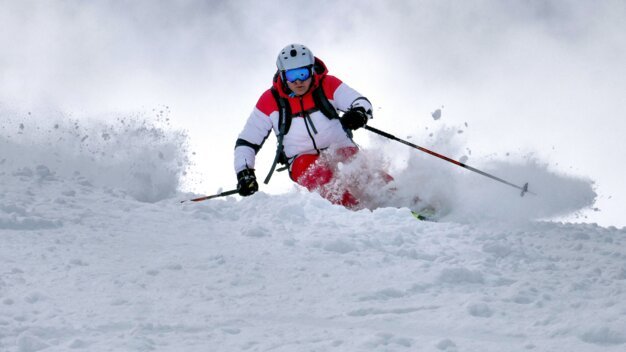
Regardless of whether you are going on a ski tour or freeriding with lift assistance: you need more than just a good deep snow ski. Your off-piste equipment should include:
- Weather-appropriate clothing: Preferably with a snow guard in your jacket and trousers so that you don't have all the snow on your skin when powder skiing.
- Avalanche equipment: Never go off-piste alone and be aware of the alpine dangers. An avalanche transceiver, probe and shovel are part of your standard gear and will help you to locate and rescue a friend or other winter sports enthusiasts in an emergency and also you need the beacon to be found as well.
- Protectors (ski helmets, etc.): Just because you're out in deep snow doesn't mean that falls are soft and fluffy. Rocks and branches can be hidden under a fresh blanket of snow.
- Ski boots: If you want to ski on surrounding slopes with your freetourer, you should make sure in advance that your ski boots are compatible with your ski bindings. A corresponding walking mechanism - walking mode for short - is a must.
- Backpack: Whether a normal or avalanche backpack, you will definitely need one of the two to store a change of clothes, first aid kit, shovel and probe as well as other important items. A checklist can help you pack the most important items.
Tip: Before you go off-piste with friends, be aware that you are now in an unsecured ski area. Avalanches and other alpine dangers can occur here. This makes it even more important to take an avalanche course to practice using your equipment.
Frequently asked questions about skis for deep snow skiing
How do you ski in deep snow?
When freeriding, make sure that your centre of gravity is in the middle of the skis. Avoid putting too much weight on your back, as this tends to cause you to sink in more, which costs you a lot of energy. On the other hand, your stance should be a little narrower to generate more uplift. When skiing in deep snow, pay particular attention to ensuring that your movements are even so that the snow underneath you can be compressed to initiate changes of direction.
Is it okay if the freeride ski is too short?
The length of your skis is directly related to your height, weight, and ability. A freeride ski that is too short can cause you to have less lift in the terrain. This can be an important safety issue in off-piste terrain.
How can you tell if freeride skis are too long?
You can usually recognise this by the fact that steering impulses require a comparatively large amount of strength. Skis that are too long can also generate so much lift that they force you backwards. Ultimately, the ski feels heavy and sluggish in the terrain, although a dynamic and active skiing style is actually required.
Are there special deep snow skis for children?
Yes, there are indeed deep snow skis for kids from some manufacturers. These are models that are significantly shorter and also have a narrower centre width than the models for adults. Because children are smaller and weigh less, the skis can be narrower and shorter. In addition, the rocker shape can be less pronounced in order to still generate sufficient lift.
INTERSPORT Rent tip
The RENTertainer recommends
If you find out during your winter holiday that the terrain is ideal for deep snow skiing, our RENTertainers will be happy to help you find the perfect deep snow skis for you. Thanks to the flexible rental options, you can swap your carving skis for a freeride model at any time. You can also get the right avalanche equipment at your local INTERSPORT Rent shop. We look forward to your visit
Related articles
You may also be interested in: